Avertissement : Ce guide est informatif et ne constitue pas un diagnostic. Les traitements mentionnés, y compris l’aphérèse thérapeutique, peuvent ne pas être utilisés dans le cadre du Covid long et sont évalués au cas par cas.
Pour certains, la COVID-19 provoque un malaise important pendant une semaine environ, puis on reprend une vie normale. Malheureusement, nombreuses sont les personnes qui en ressentent encore les effets longtemps après leur infection initiale.
Cette affection est communément appelée Covid long ou syndrome post-COVID-19. Ce guide détaille les symptômes, les mécanismes biologiques sous-jacents et les différentes options de traitement, notamment l'aphérèse proposée au Centre d'aphérèse.
Qu’est-ce que le Covid long ? Reconnaître la maladie
L'Organisation mondiale de la santé (OMS) définit le syndrome post-COVID-19 comme un état caractérisé par des symptômes qui apparaissent généralement dans les trois mois suivant l'infection par le SARS-CoV-2. Ces symptômes persistent pendant au moins deux mois et ne peuvent s'expliquer par d'autres diagnostics. Cet état, souvent invalidant, a un impact considérable sur la vie quotidienne, affectant le travail, les activités quotidiennes et le bien-être général.
D'un point de vue clinique, le Covid long ne se manifeste pas de façon uniforme ; il s'agit d'un ensemble hétérogène de symptômes susceptibles d'évoluer avec le temps. Certaines personnes peuvent souffrir de fatigue, d'essoufflement, de troubles cognitifs tels que des difficultés de concentration, de dysautonomie/syndrome de tachycardie orthostatique posturale (STOP) et de malaise post-effort. L'OMS et le NICE (NG188) ont publié des recommandations précises pour aider les médecins à prendre en charge ces cas.
Symptômes courants et cachés de la Covid-19
On recense plus de 200 symptômes associés au Covid long. Les patients constatent à la fois des signes évidents et d’autres qui peuvent être moins manifestes. Ces symptômes peuvent affecter le système nerveux, la santé cardiovasculaire, les réponses immunitaires et les fonctions autonomes. Cela entraîne des troubles complexes tels que l’intolérance orthostatique (problèmes liés à la position debout), la dysautonomie/POTS et la neuropathie des petites fibres.
La reconnaissance des signes, qu'ils soient évidents ou plus subtils, permet de différencier la Covid longue de la fatigue post-virale classique ou d'un simple manque de forme physique. Elle favorise également des examens et des traitements plus adaptés pour accompagner la guérison.
Symptômes les plus fréquemment signalés
- Fatigue insupportable : Il ne s’agit pas d’une simple fatigue. C’est un épuisement qui persiste même après une bonne nuit de sommeil. Il a tendance à s’aggraver après un effort physique ou mental (on parle alors de malaise post-effort ou MPE).
- Troubles cognitifs: le « brouillard cérébral » peut être frustrant. Pensez aux trous de mémoire, à la difficulté à trouver ses mots ou à l'impression que votre cerveau fonctionne au ralenti.
- Essoufflement : vous pourriez vous sentir facilement essoufflé ou ressentir des palpitations cardiaques, parfois liées à un dysfonctionnement du système nerveux autonome ou à des symptômes semblables à ceux du syndrome de tachycardie orthostatique posturale (STOP).
- Douleurs ou oppression thoracique : cela peut indiquer une inflammation ou d’autres problèmes sous-jacents. Il est fortement conseillé de consulter un professionnel de santé.
Symptômes souvent négligés
- Intolérance à l'effort et malaise post-effort : même une activité physique légère peut entraîner des poussées symptomatiques retardées durant plusieurs jours. Ces symptômes sont très similaires à ceux observés dans le syndrome de fatigue chronique (SFC/EM).
- Intolérance à la chaleur : De nombreuses personnes se plaignent de malaises par temps chaud en raison de problèmes de thermorégulation liés à un dysfonctionnement du système nerveux autonome. Nous abordons les stratégies d’adaptation dans l’article « Gérer l’intolérance à la chaleur liée à la Covid longue en plein été ».
- Douleurs nerveuses et picotements : si vous ressentez des sensations étranges comme des fourmillements ou des brûlures dans les extrémités, cela pourrait indiquer une neuropathie des petites fibres suite à la COVID-19.
- Problèmes intestinaux : chez certaines personnes, des changements dans les habitudes intestinales ou des altérations persistantes du goût et de l'odorat peuvent également apparaître parallèlement à des symptômes suggérant un syndrome d'activation mastocytaire (MCAS). Passez notre test de diagnostic en ligne gratuit du MCAS pour savoir si cela vous concerne.
La biologie du Covid long : pourquoi vous vous sentez encore malade
De nouvelles recherches indiquent que le Covid long pourrait être lié à plusieurs facteurs concomitants, tels que l'inflammation systémique, le dysfonctionnement endothélial, la microthrombose (formation de minuscules caillots sanguins), des troubles du système immunitaire et, dans certains cas, la persistance virale. Ces mécanismes peuvent entraver l'apport en oxygène et perturber l'équilibre de votre organisme longtemps après que vous vous soyez remis de la maladie initiale.
Au Centre d’aphérèse, nos protocoles cliniques s’appuient sur la compréhension de ces processus biologiques complexes. Nous ne nous contentons pas de traiter les symptômes ; nous nous attaquons de front aux causes profondes, telles que l’ microclots e et l’inflammation chronique.
Le rôle de Microclots et l'inflammation
Des études montrent que la majorité des personnes atteintes du « Covid long » présentent des microclots s de fibrine amyloïde qui entravent la circulation sanguine au niveau du système microvasculaire et réduisent l'apport en oxygène aux tissus, ce qui contribue à des sensations de fatigue et à des troubles cognitifs en provoquant une hypoxie tissulaire de faible intensité (c'est-à-dire un manque d'oxygène pour les cellules) ainsi qu'un stress supplémentaire pour les vaisseaux sanguins.
De nombreux patients présentent également des signes d'inflammation systémique caractérisés par une élévation des cytokines. Ces protéines inflammatoires continuent d'endommager les vaisseaux sanguins tout en stimulant les réponses immunitaires. microclots L'inflammation chronique crée un cercle vicieux qui aggrave les symptômes. C'est pourquoi les traitements ciblés du Centre d'aphérèse, qui visent à éliminer… microclots Ça a du sens.
Pour une analyse plus approfondie de ces tendances, consultez « Pourquoi vous vous sentez encore malade : la biologie cachée du Covid long ».
Dérégulation du système immunitaire
Le Covid long est également lié à un dérèglement immunitaire. On observe des modifications des profils des lymphocytes T et B, voire la formation d'auto-anticorps. Il arrive parfois que des vestiges viraux persistent dans les tissus. Cette situation peut entraîner des symptômes de type auto-immun ou des poussées chez les personnes qui souffraient déjà d'une maladie auto-immune avant de contracter la COVID-19.
Des études récentes publiées dans des revues scientifiques reconnues soulignent comment l'activation immunitaire chronique pourrait expliquer pourquoi tant de personnes présentent une grande variété de symptômes récurrents. Ces résultats confortent les stratégies thérapeutiques visant à rétablir l'équilibre immunitaire et à traiter les problèmes vasculaires.
Si vous vous interrogez sur les regroupements de symptômes et leur persistance, consultez notre article « Pourquoi le Covid long devrait être traité comme une maladie chronique ».
Parcours de soins pour le Covid long : de la gestion à l’intervention
Bien qu'il n'existe pas encore de traitement universel contre le Covid long, des approches fondées sur des données probantes permettent d'atténuer les symptômes et d'améliorer la fonctionnalité, en ciblant parfois même des problèmes sous-jacents comme ces satanées douleurs. microclots En règle générale, on commence par des soins de soutien avant de passer à des thérapies plus avancées si nécessaire.
Dans notre clinique de Larnaca, nous évaluons soigneusement chaque patient afin de déterminer si des traitements avancés comme l'aphérèse HELP ou l'INUSpheresis® seraient bénéfiques en fonction de ses besoins spécifiques, comme détaillé dans « Traitement complet du Covid long au centre d'aphérèse ».
Stratégies de gestion conventionnelles
La plupart des prises en charge commencent par les soins primaires, où les médecins s'attachent à stabiliser votre situation :
- Gestion de l'effort et de l'énergie : Apprendre à gérer son énergie permet d'éviter les coups de fatigue ; pensez à surveiller votre niveau d'activité en plus de votre fréquence cardiaque.
- Gestion des symptômes : Des médicaments destinés à soulager la douleur, à réduire l’inflammation ou à atténuer les sautes d’humeur peuvent être adaptés spécifiquement à votre cas.
- Orientation vers des services de réadaptation : Il est fréquent d’être orienté vers des séances de physiothérapie ou un soutien psychologique. Ces services sont souvent adaptés aux besoins individuels, afin d’éviter tout surmenage, notamment en cas de prédisposition à l’effort physique excessif.
Il convient de noter que les directives actualisées NICE NG188 suggèrent que la thérapie par l'exercice progressif traditionnelle n'est plus universellement adaptée, car elle peut en fait nuire aux personnes souffrant de PEM ou d'affections similaires à l'EM/SFC.
Traitement avancé : aphérèse thérapeutique
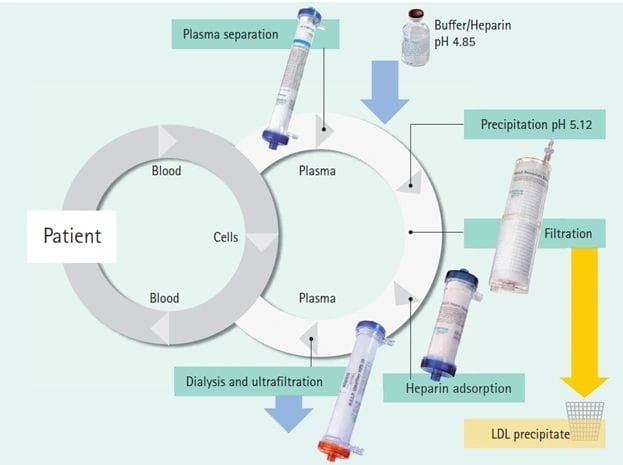
Pour les patients où microclots Si certains facteurs sont suspectés d'être à l'origine de leurs problèmes de santé persistants, l'aphérèse thérapeutique offre une approche d'intervention plus directe. Au Centre d'aphérèse, nous utilisons des méthodes comme l'aphérèse HELP (précipitation extracorporelle des lipoprotéines induite par l'héparine) selon des protocoles personnalisés visant à filtrer efficacement le sang tout en éliminant les facteurs nocifs.
H.E.L.P. L'aphérèse est spécifiquement conçue pour :
- Éliminer les tissus riches en fibrine microclots ainsi que des complexes protéiques de pointe.
- Des lipoprotéines plus faibles qui perturbent le fonctionnement des vaisseaux sanguins.
- Améliore la circulation sanguine tout en diminuant l'inflammation générale, ce qui contribue à atténuer la fatigue et à réduire la confusion mentale, améliorant ainsi la clarté d'esprit pendant les activités.
Cette procédure spécialisée se déroule sous surveillance étroite. Elle s'apparente à la dialyse, mais se concentre davantage sur le plasma que sur les fonctions rénales. Généralement, nous associons l'aphérèse HELP à d'autres thérapies de soutien, telles que la perfusion de micronutriments ou un suivi nutritionnel selon notre protocole chypriote .
Vos prochaines étapes : Vivre avec et surmonter la Covid longue
Vivre avec un Covid long peut être extrêmement difficile, mais entreprendre des démarches pour mieux comprendre sa maladie et trouver les traitements adaptés peut faire toute la différence. Combiner des techniques d'autosoins à des échanges éclairés avec les professionnels de santé vous permettra d'avancer plus sereinement vers la guérison.
Au Centre d'aphérèse, nous sommes convaincus que chaque patient mérite une attention personnalisée. Nous prenons en compte l'évolution des symptômes et les objectifs personnels lors de l'élaboration des plans de traitement pour les personnes souffrant de complications liées à la Covid longue.
Quelles questions poser à votre médecin
Bien se préparer à ses consultations médicales est essentiel. Voici quelques questions à se poser :
- « Mes symptômes pourraient-ils indiquer un Covid long ? Existe-t-il d'autres causes potentielles que nous devrions explorer ? »
- « Peut-on effectuer des tests pour évaluer les niveaux d’inflammation ou les problèmes de coagulation sanguine ? »
- « Quelles options de traitement vont au-delà du simple soulagement des symptômes ? Existe-t-il une solution de réadaptation ? »
Et si vous êtes intéressé par des thérapies axées sur microclots En cas d'inflammation, renseignez-vous sur les centres spécialisés en aphérèse thérapeutique.
Trouver le bon soutien
Il est essentiel de trouver des spécialistes maîtrisant tous les aspects de la dysautonomie/microthrombose ainsi que les principes de réadaptation pour faire face aux défis posés par le Covid long. De nombreux patients bénéficient d'une prise en charge multidisciplinaire incluant notamment des cardiologues, qui comprennent comment répondre au mieux à leurs besoins spécifiques, y compris des interventions avancées si nécessaire.
Dans notre centre de Larnaca, nous proposons des consultations approfondies visant à déterminer si des traitements comme l'aphérèse HELP correspondent bien aux parcours de santé individuels.
FAQ
Combien de temps peut durer le Covid long ?
La durée des cas varie considérablement, mais certaines études montrent que des personnes continuent de présenter des symptômes persistants même au-delà de 12 mois ; beaucoup constatent toutefois une amélioration progressive au fil du temps.
Quels tests permettent d'éliminer d'autres causes ?
Les cliniciens peuvent utiliser des analyses sanguines pour évaluer les marqueurs inflammatoires/la fonction cardiaque, parallèlement à des évaluations neurologiques visant à identifier précisément les causes du syndrome post-COVID.
Le Covid long est-il la même chose que l'EM/SFC ?
Bien qu'ils présentent des similitudes, comme une fatigue intense, le « COVID long » est spécifiquement lié aux séquelles de l'infection par le SARS-CoV-2, tandis que l'EM/SFC répond à des critères plus larges qui dépassent le simple cadre viral.
Qui ne devrait pas envisager l'aphérèse ?
L'aphérèse thérapeutique ne convient pas à tous. Des facteurs tels que des troubles hémorragiques non contrôlés ou des affections médicales graves nécessitent une évaluation approfondie préalable, indispensable avant tout traitement.
-
Note de l'auteur / de la relecture médicale
Ce guide a été relu par le Dr Irina Pavlik Marangos, médecin au Centre d’aphérèse, spécialisée principalement dans l’aphérèse thérapeutique et les disciplines connexes, et forte de plus de 15 ans d’expérience dans les domaines de la médecine interne et des thérapies extracorporelles.
Références clés
– Fiche d’information de l’Organisation mondiale de la santé [États-Unis après une infection à la COVID-19] (https://www.who.int/news-room/fact-sheets/detail/post-covid-19-condition-%28long-covid%29)
– Recommandation NICE NG188 [Gestion des effets à long terme] (https://www.nice.org.uk/guidance/ng188)
– Taquet M et al., Effets neuropsychiatriques à long terme. Psychiatrie moléculaire
– Pretorius E et al., Pathologie persistante des protéines de coagulation. Cardiovascular Diabetology
Signatures :
Rédigé par Andrew Smith. Révisé par le Dr Irina Pavlik Marangos, du Centre d’aphérèse de Chypre. Médecin spécialisée dans l’aphérèse thérapeutique HELP , les maladies chroniques complexes et les affections post-virales, elle supervise l’évaluation et la sécurité des patients au sein de la clinique.